Cash accounts
Only needed if the tenant exports payments, one per payment method. The payment books debit cash account, credit debtor, a refund the other way round, always against the same personal account as the invoice.
In the "Accounts" tab you assign a revenue account to every tax rate, a cash account to every payment method and a debtor to the customers. For the revenue accounts the standard accounts of the chart are suggested.
Every tax rate that orders actually carry needs a revenue account - otherwise the export stops. The assistant suggests the standard accounts for 19% and 7%.
your-shop.com/admin
Orders › DATEV export › Tenants
Muster Handels GmbH
CancelSave
Master dataBookingAccountsTax & OSSExportSales channels
No revenue account for the tax rate 7 %. Documents with that rate cannot be booked - your tax advisor knows which account is right.
Revenue accounts per tax rate
1 openWhere your sales are posted - mandatory for your shop’s own rates
Your tax rates
Revenue 19 %
8400
Revenue 7 %Without an account the export blocks documents carrying this rate. Adopt standard 8300
standard 8300
Money accounts per payment method
Where the money lands - only with the payment export on
Prepayment
1200
Invoice
1200
PayPalWithout an account the payment is not booked.
e.g. 1200 (bank) or 1000 (cash)
The debtor is the personal account the revenue is booked against. A collective debtor is required whichever way you choose - a personal account like 10000, not the control account 1400 or 1200, which DATEV does not let you book directly.
With individual debtors the number has to fit the range of personal accounts, 10000 to 69999 with four-digit accounts; anyone without a usable number books to the collective debtor and is named in the check report. The tax firm imports the master data before the booking batch.
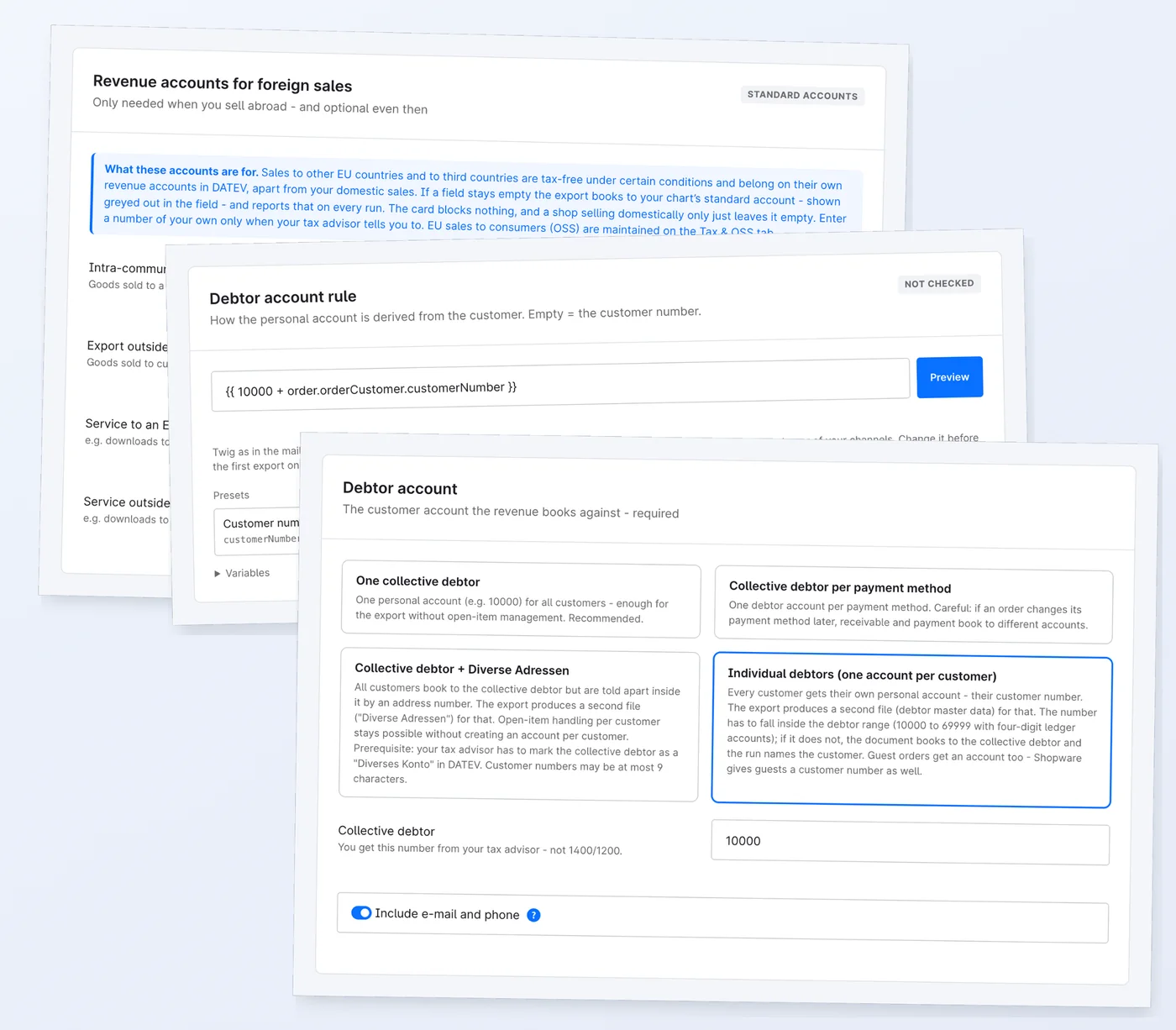
Only needed if the tenant exports payments, one per payment method. The payment books debit cash account, credit debtor, a refund the other way round, always against the same personal account as the invoice.
With two or more channels every account line can be set differently per channel. Only the debtor stays the same for all channels.
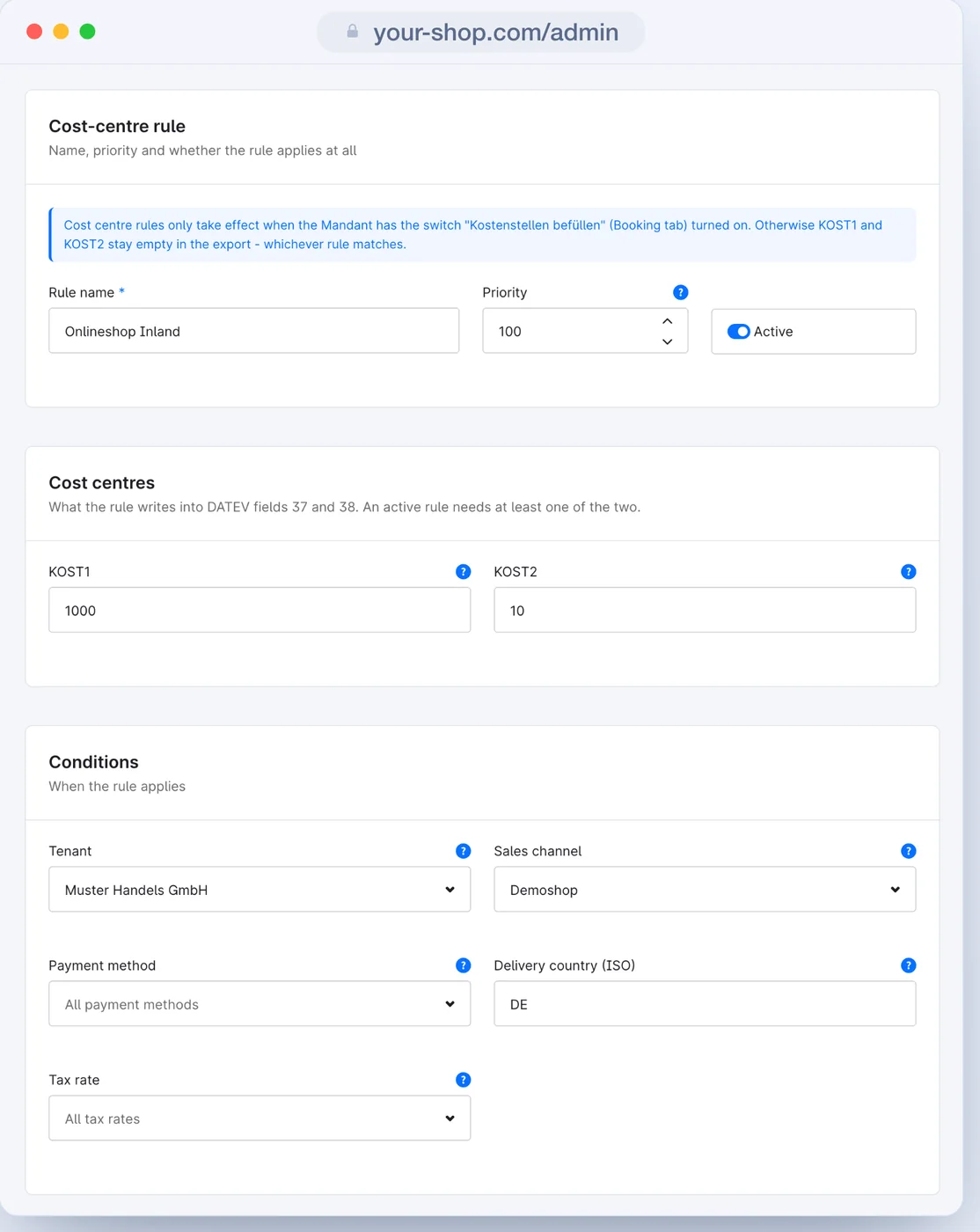
Rules with a priority assign KOST1 and KOST2, by tenant, channel, payment method, delivery country and tax rate. They never change account, amount or tax.
All active rules are checked by priority, per booking line: a document with 19% and 7% can get two cost centres. An empty condition field means "any" - a rule without a condition at priority 0 catches everything else.
The ones the tax firm specifies. The plugin suggests the standard accounts of SKR03 and SKR04; every one of them can be overridden on the tenant.
Then the document books to the collective debtor and the check report names it with the rejected number. The revenue is complete; only the assignment to the customer is missing at the tax firm.
What a tenant is, the five-step assistant and when you need several.
Period, preview, test export and export, the running run and the history.
Errors that stop and notices that do not - and the way to fix each one.
Every setting on the tenant and the global switches, with default and effect.
Booking batch, general reversal, freeze and the other words from DATEV and Shopware.